

How Gold Buyers Determine the Value of Gold Jewelry
August 26, 2026A diamond may appear simple: a transparent crystal made of carbon. Scientifically, however, diamond is far more complex. Its atomic structure, trace elements, crystal defects, inclusions, growth patterns and geological history can reveal an extraordinary amount of information about how the diamond formed and, in many cases, why one diamond may be considerably rarer and more valuable than another.
At Pro Diamond Buyers, understanding those differences is an important part of professional diamond evaluation. Two diamonds can have similar carat weight, color and clarity grades and still have very different origins, internal structures, rarity and market significance. Modern diamond evaluation therefore goes well beyond simply looking at the traditional 4Cs.
This guide explains what a diamond actually is, how natural diamonds form, why natural diamonds are rare, the scientific differences between Type I and Type II diamonds, how laboratory-grown diamonds are produced by HPHT and CVD methods, and how gemologists can distinguish laboratory-grown diamonds from diamonds formed naturally within the Earth.
What Is a Diamond Made Of?
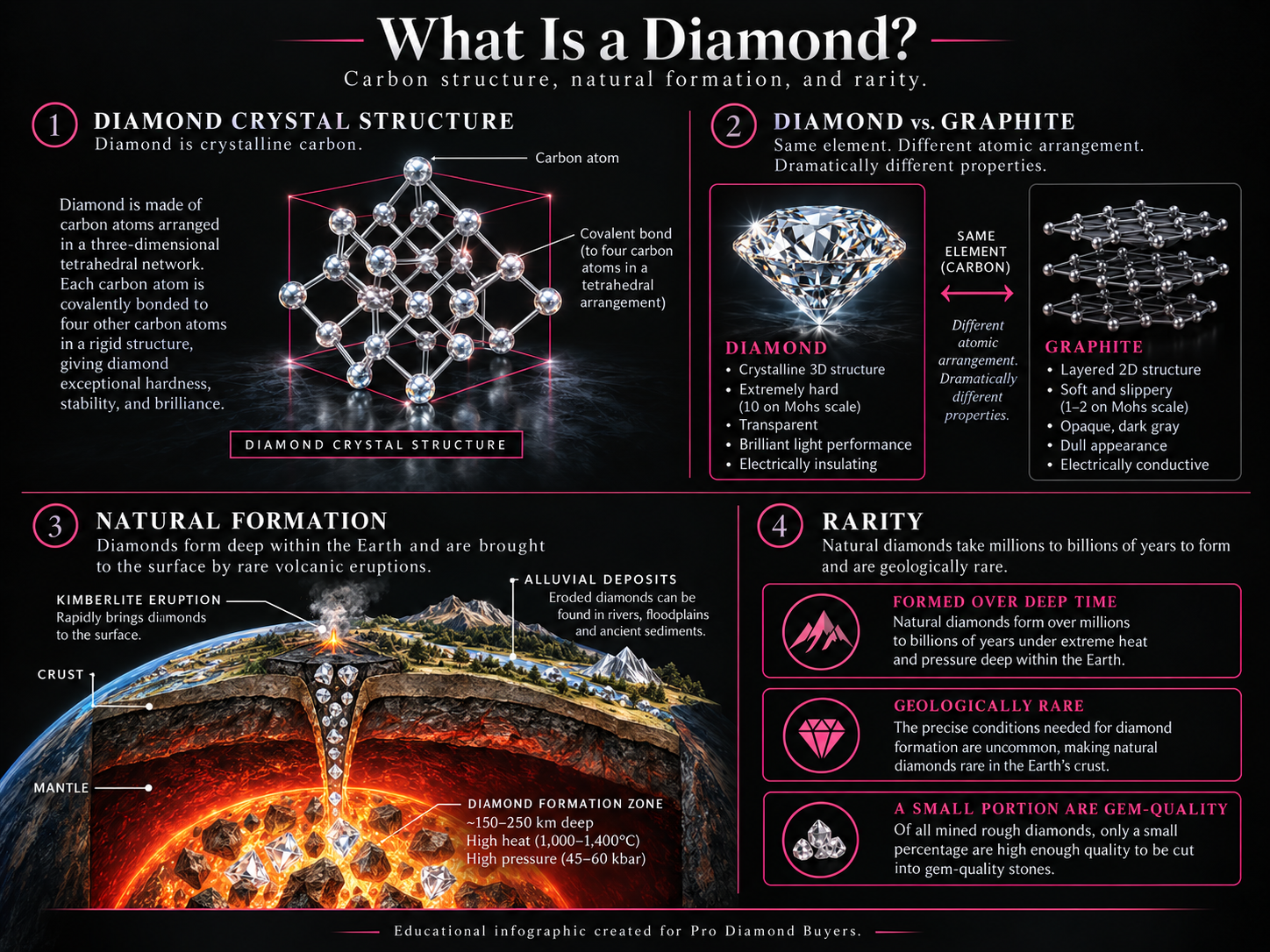
Diamond is a crystalline form of the element carbon. Carbon is also present in graphite, coal and many other materials, but the arrangement of carbon atoms in diamond is dramatically different.
In a diamond crystal, each carbon atom is strongly bonded to four neighboring carbon atoms in a three-dimensional tetrahedral arrangement. These are primarily sp3 covalent bonds. The repeating atomic arrangement forms what is known as the diamond cubic crystal structure.
This extremely strong three-dimensional network is responsible for many of diamond’s remarkable physical properties. Diamond is the hardest naturally occurring mineral, has exceptional thermal conductivity, has a high refractive index, and is capable of separating white light into spectral colors through optical dispersion.
The important point is that a diamond is more than simply “carbon.” The exact arrangement of its atoms, the presence or absence of trace elements, vacancies in the crystal lattice, strain, inclusions and other microscopic features can provide information about the diamond’s history.
How Carbon Atoms Create the Diamond Crystal Structure
The strength of diamond begins with its atomic lattice. Every carbon atom is bonded in three dimensions rather than arranged in flat sheets. By comparison, graphite is also carbon, but its atoms are arranged in layers that can slide across one another easily. That is one reason graphite is soft while diamond is exceptionally hard.
The diamond lattice is not always perfectly uniform. During natural growth, small amounts of other elements can become incorporated into the crystal. Nitrogen is by far the most important impurity in most natural diamonds. Boron can occur in some rare diamonds. Vacancies, displaced atoms and other defects can also occur.
To a gemologist, these are not insignificant imperfections. They can affect color, fluorescence, electrical behavior, spectroscopy and even help reveal how the diamond formed.
Why Diamonds Are So Hard — and Why They Can Still Break
Diamond’s tightly bonded carbon structure gives it a hardness of 10 on the Mohs scale. Hardness refers primarily to resistance to scratching. This is why diamond can scratch virtually every other natural mineral.
Hardness should not be confused with toughness. Diamonds have distinct cleavage directions within their crystal structure. A sufficiently strong blow delivered in the proper direction can cause a diamond to chip or cleave.
This distinction is important when evaluating older jewelry. A diamond can resist surface abrasion remarkably well while still exhibiting chips, bruises or fractures caused by impact.
How Natural Diamonds Form Deep Within the Earth
Natural diamonds are products of extraordinary geological conditions. According to research and educational material published by the Gemological Institute of America, many natural diamonds formed hundreds of millions to billions of years ago, with many forming more than one billion years ago.
Most gem-quality natural diamonds formed deep in Earth’s mantle at depths commonly measured in the hundreds of kilometers. Under tremendous pressure and elevated temperatures, carbon-bearing fluids or melts provided the carbon from which diamond crystals could grow.
Formation was only part of the journey. A diamond also had to survive within the mantle and then be transported rapidly toward Earth’s surface by unusual volcanic eruptions associated primarily with kimberlite or, less commonly, lamproite magma.
Many diamonds never survived that journey. Others remained locked underground. Of the material eventually brought toward the surface, only a portion became recoverable gem-quality diamond.
A natural diamond is therefore not simply a piece of crystallized carbon. It is the surviving product of an ancient sequence of geological events that cannot be repeated on demand in nature.
Why Natural Diamonds Are Rare
Rarity has always been an important concept in gemology. GIA educational material traditionally discusses beauty, durability and rarity as fundamental characteristics associated with important gem materials.
Natural diamonds possess geological scarcity. They require unusual conditions to form, they must survive for immense periods of time, they must be transported toward the surface without being destroyed, and they must occur in a deposit that can ultimately be discovered and economically recovered.
Rarity becomes even more important when individual characteristics are considered together. A natural diamond may become progressively rarer as desirable characteristics are combined:
- larger carat weight,
- higher color grade,
- higher clarity,
- exceptional natural fancy color,
- unusual diamond type,
- desirable proportions and cut quality,
- important provenance, or
- an exceptionally unusual combination of these characteristics.
This is why value within the natural diamond market does not increase in a simple straight line. As particular combinations become substantially harder to find, scarcity can increase dramatically.
Diamond Types Explained: Type Ia, Ib, IIa and IIb
One of the least understood areas of diamond science among consumers is diamond type.
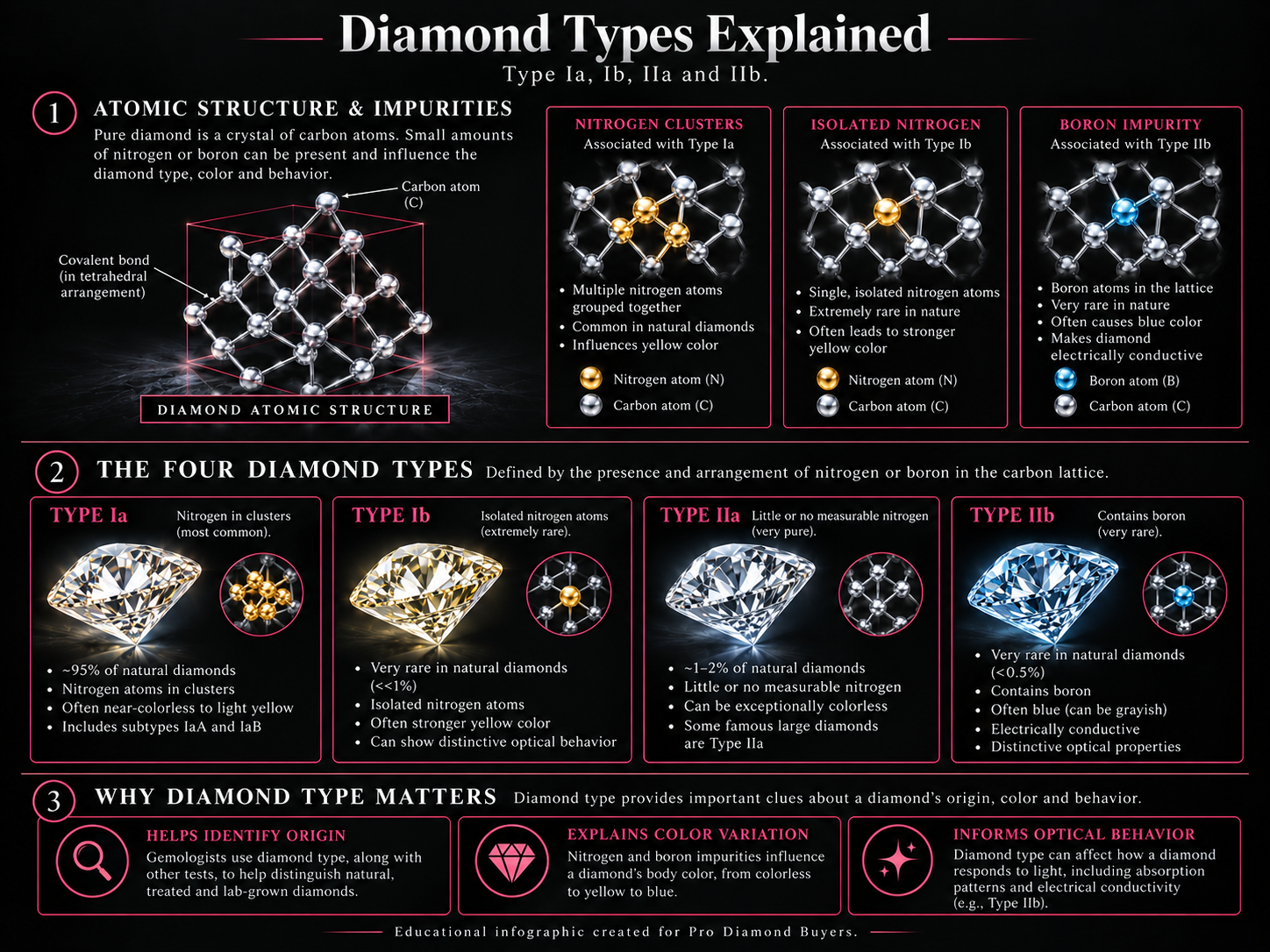
Natural diamonds are not all chemically identical in the fine details of their crystal lattice. Gemologists classify diamonds broadly as Type I or Type II depending primarily on the presence, absence and arrangement of nitrogen, with additional subdivision into Type Ia, Type Ib, Type IIa and Type IIb.
This classification can provide important information about a diamond’s chemistry, growth history, color and potential response to advanced testing.
Type Ia Diamonds
Type Ia diamonds contain nitrogen atoms that have aggregated, or grouped together, within the diamond lattice. GIA reports that approximately 95 percent of natural diamonds are Type Ia.
Type Ia can be subdivided further. In simplified terms, Type IaA diamonds contain nitrogen largely arranged in pairs, while Type IaB diamonds contain larger nitrogen aggregates associated with vacancies in the crystal lattice. Many diamonds contain mixtures of these forms.
The aggregation of nitrogen can be related to the enormous temperatures and geological time experienced by a natural diamond after its formation.
Type Ib Diamonds
Type Ib diamonds contain nitrogen primarily as isolated individual atoms rather than aggregated groups. Natural Type Ib diamonds are extremely uncommon.
Isolated nitrogen can produce strong yellow coloration, which is why some intensely yellow natural diamonds fall within this category.
Type IIa Diamonds
Type IIa diamonds contain little or no nitrogen detectable by the infrared methods used for diamond type classification. They represent a small percentage of natural diamonds and include some exceptionally important natural stones.
Because they contain very little measurable nitrogen, Type IIa diamonds can be exceptionally transparent to certain portions of the electromagnetic spectrum. Their crystal structure can nevertheless contain other defects, strain or characteristics that reveal information about their history.
Natural Type IIa diamonds are particularly important in modern gemology because many colorless or near-colorless laboratory-grown diamonds are also Type II. A Type II result therefore does not mean that a diamond is laboratory-grown. Instead, it tells the gemologist that additional examination may be necessary.
Type IIb Diamonds
Type IIb diamonds contain boron within the crystal lattice. Boron can produce blue to gray-blue coloration and can make diamond electrically conductive, an unusual property among diamonds.
Natural Type IIb diamonds are very rare and include some historically important blue diamonds.
Why Nitrogen, Boron and Crystal Defects Matter
The distinction between Type Ia, Ib, IIa and IIb illustrates an important reality: diamonds are more scientifically complicated than they appear in a jewelry showcase.
Trace elements and crystal defects can affect:
- body color,
- fluorescence and phosphorescence,
- electrical conductivity,
- infrared absorption,
- photoluminescence spectra,
- response to treatments, and
- the testing required to establish natural or laboratory-grown origin.
A diamond’s type alone does not determine its origin or its value. It is one piece of a larger scientific examination.
What Is a Lab-Grown Diamond?
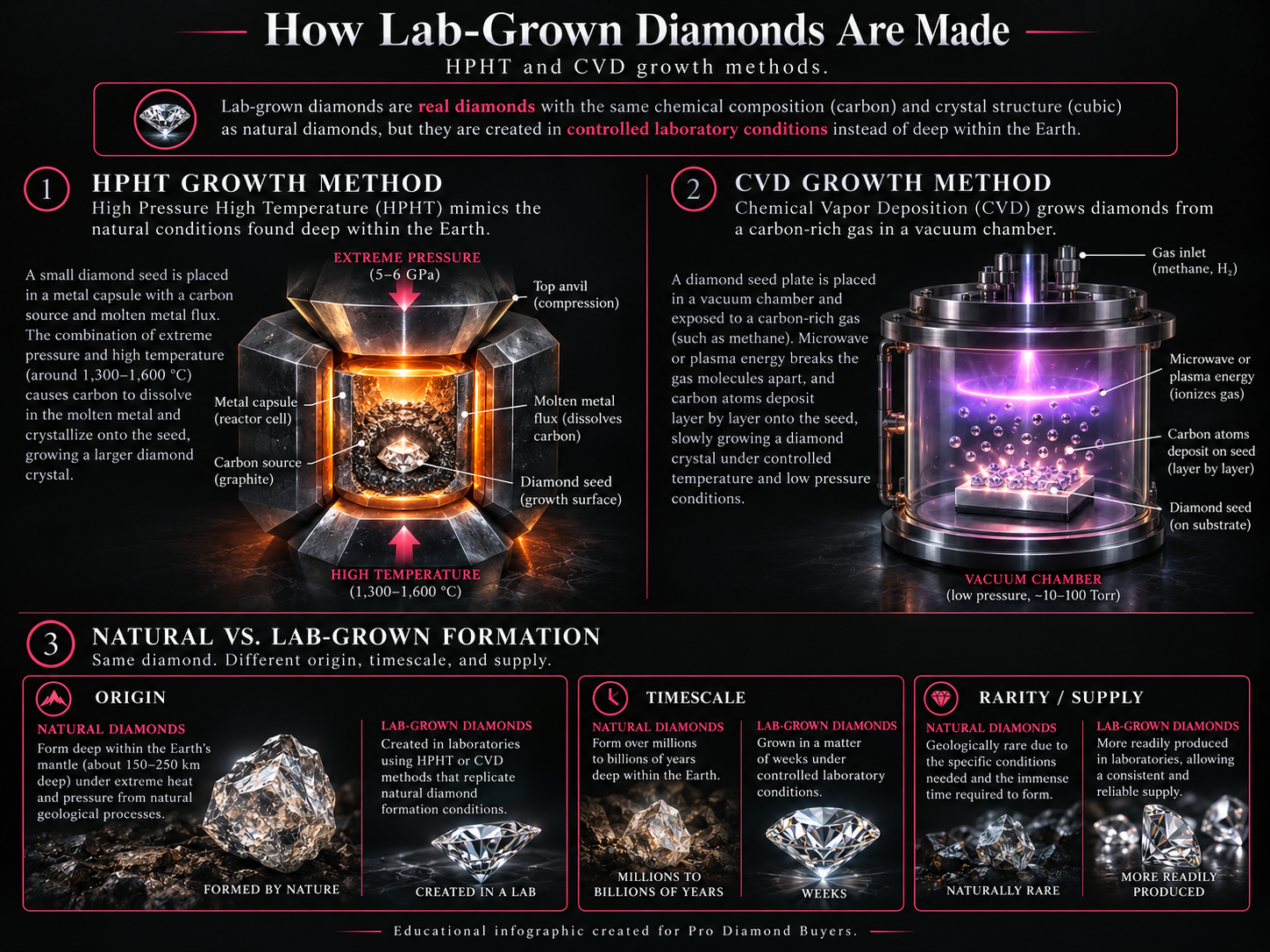
A laboratory-grown diamond is a real diamond. It is not cubic zirconia, moissanite or another diamond simulant.
Laboratory-grown diamonds consist of crystallized carbon arranged in the diamond structure. They can have essentially the same hardness, refractive properties and general chemical composition as natural diamonds.
The critical difference is origin.
A natural diamond formed through geological processes within the Earth. A laboratory-grown diamond was produced in a controlled manufacturing environment using technology designed to create diamond crystal growth.
Today there are two principal commercial methods for producing gem-quality laboratory-grown diamonds: High Pressure High Temperature, known as HPHT, and Chemical Vapor Deposition, known as CVD.
How HPHT Lab-Grown Diamonds Are Made
HPHT stands for High Pressure High Temperature. The method recreates some of the high-pressure conditions associated with natural diamond stability, but it does so inside engineered equipment designed to accelerate and control diamond growth.
A small diamond seed is placed inside a growth cell along with a carbon source, commonly graphite, and a metallic flux or catalyst. The assembly is subjected to enormous pressure, typically in the range of approximately 5 to 6 gigapascals, while temperatures commonly reach approximately 1,300 to 1,600 degrees Celsius.
At these conditions, the metallic material melts and helps dissolve carbon from the carbon source. A controlled temperature difference within the growth chamber causes carbon to migrate through the molten material toward the diamond seed. Carbon atoms then crystallize onto the seed, enlarging the diamond crystal.
Depending on the desired size and quality, HPHT growth can occur over periods ranging from hours to weeks.
Because HPHT diamond growth takes place in a manufactured environment, it can leave characteristic evidence. Depending on the specific growth process, HPHT-grown diamonds may display geometric growth sectors, characteristic color zoning, metallic flux inclusions, unusual fluorescence behavior and, in some stones, strong phosphorescence.
None of these observations should be used alone as absolute proof of origin. Modern identification relies on several observations and, when necessary, advanced spectroscopy.
How CVD Lab-Grown Diamonds Are Made
CVD stands for Chemical Vapor Deposition. It produces diamond using a very different process from HPHT.
Thin diamond seed plates are placed inside a low-pressure growth chamber. The chamber contains a mixture of gases, usually dominated by hydrogen with a smaller amount of a carbon-containing gas such as methane.
An energy source, commonly microwaves, creates a plasma within the chamber. The plasma activates chemical reactions that separate carbon-containing species from the gas mixture. Under carefully controlled conditions, carbon atoms are deposited onto the diamond seed surface.
Layer by layer, the diamond grows upward from the seed.
CVD growth normally occurs at much lower pressure than HPHT growth and commonly at temperatures roughly in the range of 700 to 1,200 degrees Celsius depending on the process. Commercial production frequently requires multiple growth cycles and can take several weeks.
Hydrogen is especially important because it helps suppress non-diamond forms of carbon while favoring continued diamond growth.
Many CVD-grown diamonds are subjected to additional treatment after growth, including HPHT treatment intended to alter undesirable color or improve appearance.
Like HPHT growth, CVD growth can leave identifiable evidence. CVD diamonds may display layered growth structures, characteristic strain patterns, graphitic inclusions, fluorescence structures and atomic-scale defects associated with the growth environment.
Natural Diamonds vs. Lab-Grown Diamonds: What Is Actually Different?
At the most basic materials-science level, both are diamond. Both consist principally of carbon in the diamond crystal structure.
But material composition does not make their histories identical.
A natural diamond is a geological object. Its growth, residence within the mantle, transport toward Earth’s surface and survival occurred through natural processes over immense spans of geological time.
A laboratory-grown diamond is a manufactured diamond crystal produced through a controlled and repeatable industrial process.
The difference between them therefore lies primarily in origin, growth environment, geological history, certain crystal characteristics and scarcity.
If Lab-Grown Diamonds Are Real Diamonds, How Can We Detect Them?
This is one of the most important questions in modern gemology.
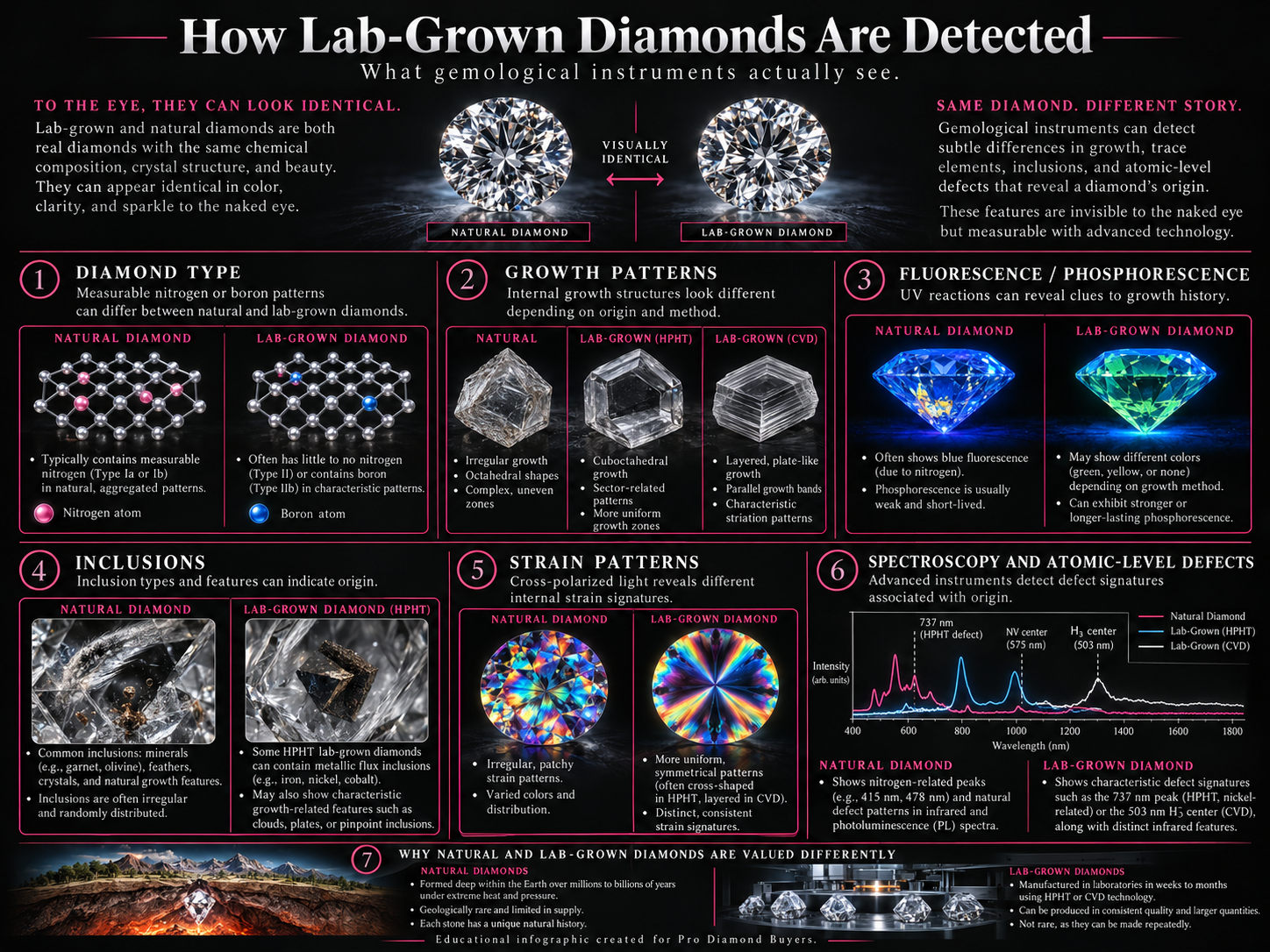
A laboratory-grown diamond is not detected because an instrument determines that it is “fake.” It is detected because the diamond crystal can retain measurable evidence of how and where it grew.
Natural, HPHT-grown and CVD-grown diamonds experience fundamentally different growth environments. Those environments can produce different populations and arrangements of atomic defects, trace elements, inclusions, growth structures and luminescence behavior.
Modern diamond screening and laboratory equipment takes advantage of those differences.
Diamond Type
Determining whether a diamond is Type I or Type II can be an important first screening step. Most natural diamonds are Type Ia, while many colorless and near-colorless laboratory-grown diamonds fall within Type II categories.
However, some very rare and important natural diamonds are also Type II. For that reason, diamond type is a screening tool — not a final origin determination.
Growth Patterns
A crystal records the geometry of its growth.
HPHT-grown diamonds can display growth sectors associated with the different crystal directions that developed inside the high-pressure growth cell. Under appropriate imaging, these sectors may form geometric or cross-like patterns.
CVD diamonds grow primarily in layers from relatively flat seed plates. Deep-ultraviolet imaging may reveal layered or striated structures related to this deposition process.
Natural diamonds grow under much more variable geological conditions and can display different combinations of octahedral growth, irregular zoning and complex internal structures.
Fluorescence and Phosphorescence
Ultraviolet light can cause some diamonds to emit visible light. This is fluorescence. If the emission continues after the ultraviolet source is removed, it is known as phosphorescence.
GIA research has shown that fluorescence and phosphorescence patterns can help screen natural and laboratory-grown diamonds. Many natural fluorescent diamonds react more strongly to long-wave ultraviolet radiation, while many laboratory-grown diamonds can show stronger reactions to short-wave radiation.
Long-lasting blue-green phosphorescence is particularly associated with many colorless HPHT-grown diamonds, although exceptions exist. Certain natural Type IIb diamonds can also phosphoresce.
For this reason, fluorescence or phosphorescence alone should never be considered conclusive.
Inclusions
Inclusions can provide further clues.
HPHT-grown diamonds may contain remnants of metallic flux used during the growth process. CVD-grown diamonds may contain dark graphitic inclusions or other features related to their manufacturing environment.
Natural diamonds may contain minerals or other inclusions produced deep within the Earth. Some natural diamond inclusions are scientifically important because they can preserve material from environments humans could otherwise never directly sample.
Strain Patterns
Polarized-light examination can reveal internal strain within diamond crystals. Natural diamonds and CVD-grown diamonds can develop different strain patterns because their growth and post-growth histories are different.
Again, strain is part of the evidence rather than a stand-alone determination.
Spectroscopy and Atomic-Level Defects
The most sophisticated identification methods examine what cannot be seen with the unaided eye or even a conventional microscope.
Infrared absorption, ultraviolet-visible spectroscopy and photoluminescence spectroscopy can reveal impurity atoms, vacancies and defect centers within the diamond lattice.
The type, concentration and arrangement of those defects can provide powerful evidence regarding whether the crystal formed naturally or by HPHT or CVD growth.
This is why advanced gemological laboratories can identify laboratory-grown diamonds even when they are visually indistinguishable from natural diamonds.
What Does a Lab-Grown Diamond Detector Actually See?
Different screening instruments use different technologies, but the principle is similar: the instrument is looking for properties associated with the diamond’s growth history.
Some instruments examine ultraviolet fluorescence. Others analyze absorption behavior or spectroscopic signatures. More advanced laboratory instruments can image growth structures or measure very specific atomic defect centers.
The important concept for consumers is simple:
The instrument is not detecting whether the material is diamond. It is detecting evidence of how that diamond crystal was grown.
That distinction is one reason professional diamond identification has become considerably more sophisticated in the laboratory-grown era.
Beauty, Durability and Rarity: Why Natural Origin Matters
Gemology has traditionally associated important gemstones with three fundamental qualities: beauty, durability and rarity.
Laboratory-grown diamonds can reproduce the beauty and extraordinary durability of diamond material. What they do not reproduce is natural geological rarity.
Natural diamond supply is constrained by geology. Humans cannot instruct the Earth to produce another rare natural diamond with a particular combination of size, color, clarity, diamond type and growth history.
Laboratory-grown supply operates differently. Manufacturing capacity can be expanded. Additional reactors can be constructed. Processes can become faster and more efficient. Production recipes can be improved, and manufacturers can increasingly target particular sizes, colors and qualities.
That does not make laboratory-grown diamonds fake. It means their scarcity is fundamentally different.
From a supply standpoint, laboratory-grown diamonds function much more like a controlled manufactured commodity than a naturally scarce geological resource.
Why Natural and Lab-Grown Diamonds Are Valued Differently
Natural rarity has historically been one of the foundations of diamond value.
As natural diamonds become larger, cleaner, more colorless or possess an unusually desirable natural color, the combination can become increasingly difficult to find. That increasing scarcity can result in substantial differences in market value.
Laboratory-grown diamonds do not face the same geological constraint. If sufficient demand exists for a particular commercial size or quality, manufacturers can attempt to produce additional material meeting those specifications.
For that reason, the natural and laboratory-grown diamond markets should not be assumed to behave the same merely because the finished stones may look similar.
At Pro Diamond Buyers, we consider origin an essential part of understanding a diamond’s market. A laboratory-grown diamond can be attractive, durable and technically sophisticated while still occupying a fundamentally different rarity and value category from a comparable natural diamond.
Why the 4Cs Are Only Part of a Professional Diamond Evaluation
The 4Cs — carat weight, color, clarity and cut — remain essential tools for describing diamond quality. But they do not tell the entire story.
A professional evaluation may also consider:
- whether the diamond is natural or laboratory-grown,
- diamond type,
- possible treatments,
- fluorescence and phosphorescence,
- natural or artificial color origin,
- crystal strain,
- inclusion characteristics,
- cut proportions, symmetry and polish,
- condition and damage,
- grading laboratory documentation,
- market demand,
- rarity within the particular category, and
- whether unusual characteristics warrant additional laboratory testing.
This is particularly important today because a stone that tests positively as diamond with a basic thermal tester has not necessarily been proven to be a natural diamond. Natural and laboratory-grown diamonds are both diamond and can respond similarly to traditional diamond-testing equipment.
How Pro Diamond Buyers Evaluates Natural and Lab-Grown Diamonds
At Pro Diamond Buyers, diamond evaluation begins with the understanding that not every diamond can be properly characterized by appearance alone.
We evaluate diamonds from the perspective of both gemology and the professional diamond market, including the additional considerations involved when evaluating GIA-certified diamonds. That means considering not only color, clarity, cut and carat weight, but also origin, diamond type, treatments, fluorescence, condition, documentation, rarity and current marketability when those factors are relevant.
Some diamonds are straightforward. Others require considerably more knowledge.
A Type Ia natural diamond, a rare natural Type IIa stone, an HPHT-grown diamond, a CVD-grown diamond, an HPHT-treated natural diamond and a naturally colored diamond can all present very different identification and valuation questions — even when several may initially appear similar to an untrained observer.
That complexity is one reason specialized diamond knowledge matters when selling or evaluating significant stones.
A Diamond Is More Than What You See
A polished diamond may appear to be a simple transparent gemstone, but inside that crystal is a remarkable amount of information.
Its carbon lattice tells us why diamond is so hard. Nitrogen and boron can influence its type and color. Atomic defects can produce fluorescence or reveal growth history. Inclusions can preserve evidence of formation conditions. Growth structures can help distinguish natural crystals from diamonds produced using HPHT or CVD technology.
Most importantly, natural diamonds carry a geological history that laboratory manufacturing cannot reproduce.
Laboratory-grown diamonds are genuine diamonds. They demonstrate an impressive ability to reproduce the diamond crystal in a controlled environment. But reproducing diamond material is not the same as reproducing natural geological rarity.
For natural diamonds, rarity can increase dramatically as exceptional characteristics occur together. That scarcity, combined with beauty, durability, history and market demand, is why natural diamonds and laboratory-grown diamonds are not valued as interchangeable products.
Understanding those distinctions requires more than a loupe and a basic diamond tester. Modern gemology combines observation, instrumentation, crystal chemistry and market knowledge to understand exactly what a diamond is — and what makes that particular diamond important.
Scientific Sources and Further Reading
This article was written by Pro Diamond Buyers using our professional diamond and gemological experience together with scientific information published by the Gemological Institute of America. The scientific concepts have been independently explained in our own words for educational purposes.
- GIA — Diamond Gem Overview
- GIA — The Origin of a Natural Diamond
- GIA — Diamond Types: Ia, Ib, IIa and IIb
- GIA — HPHT and CVD Diamond Growth Processes
- GIA — Laboratory-Grown Diamonds: Identification and Research Update
- GIA — Natural, Laboratory-Grown and Diamond Simulant Identification
Pro Diamond Buyers is an independent diamond and precious-metals buyer. References to GIA are provided for scientific and educational sourcing and do not imply sponsorship or endorsement by GIA.


