
What Is a Diamond? The Science, Structure, Rarity and Natural Origin of Diamonds
October 6, 2026Gold testing is much more involved than checking a stamp or touching a piece of jewelry with a magnet. Professional gold identification combines chemistry, density, visual inspection, construction knowledge and, when appropriate, advanced instruments such as X-ray fluorescence.
At Pro Diamond Buyers, accurate gold testing is important because purity directly affects value. When someone sells gold jewelry, coins and bullion or scrap gold, the first responsibility of the buyer is to determine what the item actually contains before calculating an offer.
This guide explains the major methods used to test gold, why acid testing remains one of the most useful benchmark techniques in professional buying, how XRF and specific gravity complement traditional methods, and why plated, repaired or mixed-metal jewelry can sometimes produce misleading results.
What Does Gold Testing Actually Determine?
Gold testing attempts to determine whether an item contains gold and, if so, approximately how much gold is present in the alloy.
Pure gold is 24 karat. Most jewelry, however, is made from gold alloyed with other metals to improve strength, change color or reduce cost. Common jewelry purities include:
- 10K gold — approximately 41.7 percent gold
- 14K gold — approximately 58.5 percent gold
- 18K gold — approximately 75 percent gold
- 22K gold — approximately 91.6 percent gold
- 24K gold — essentially pure gold
The remaining portion of the alloy may contain silver, copper, nickel, palladium, zinc or other metals depending on the karat, color and manufacturing process.
Because different alloys can look remarkably similar, appearance alone cannot reliably determine purity.
Hallmarks and Visual Inspection
The first stage of professional gold testing often begins before any chemical or electronic test is performed.
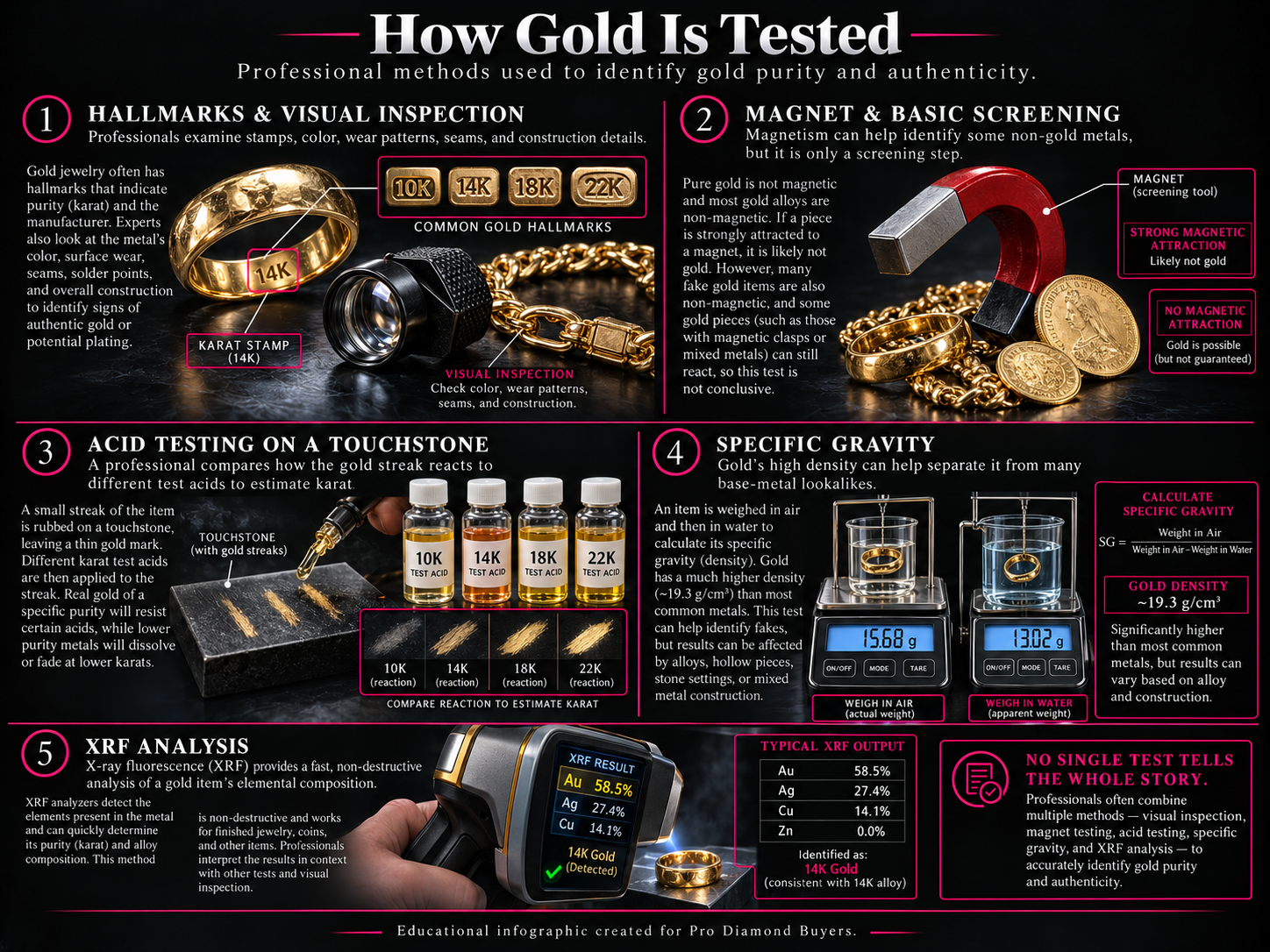
Experienced buyers examine hallmarks, color, wear patterns, seams, solder joints, clasp construction, manufacturing style and areas where plating may have worn through.
Common marks such as 10K, 14K, 18K, 22K, 417, 585, 750 and 916 can provide useful information, but a hallmark is not proof by itself. Stamps can be incorrect, counterfeit or placed on an item that has been repaired using metals of a different purity.
Visual inspection can also reveal clues that a piece may be plated, gold-filled, hollow, mixed metal or heavily repaired.
Magnet Testing: Useful Screening, Not Proof
Pure gold is not magnetic, and most common gold alloys are not strongly magnetic. For that reason, a magnet can be useful as an initial screening tool.
If a jewelry item is strongly attracted to a magnet, that is evidence that substantial amounts of iron, steel or another magnetic material may be present.
However, the opposite conclusion is not valid. An item that is not attracted to a magnet has not been proven to be gold. Many common base metals used in imitation jewelry are also nonmagnetic.
Some genuine gold jewelry can also contain small magnetic components, springs, clasps or repair materials. Magnetism therefore provides information, but it should never be used as the sole test for gold.
How Gold Acid Testing Works
Acid testing is one of the oldest and most useful practical methods for estimating gold purity.
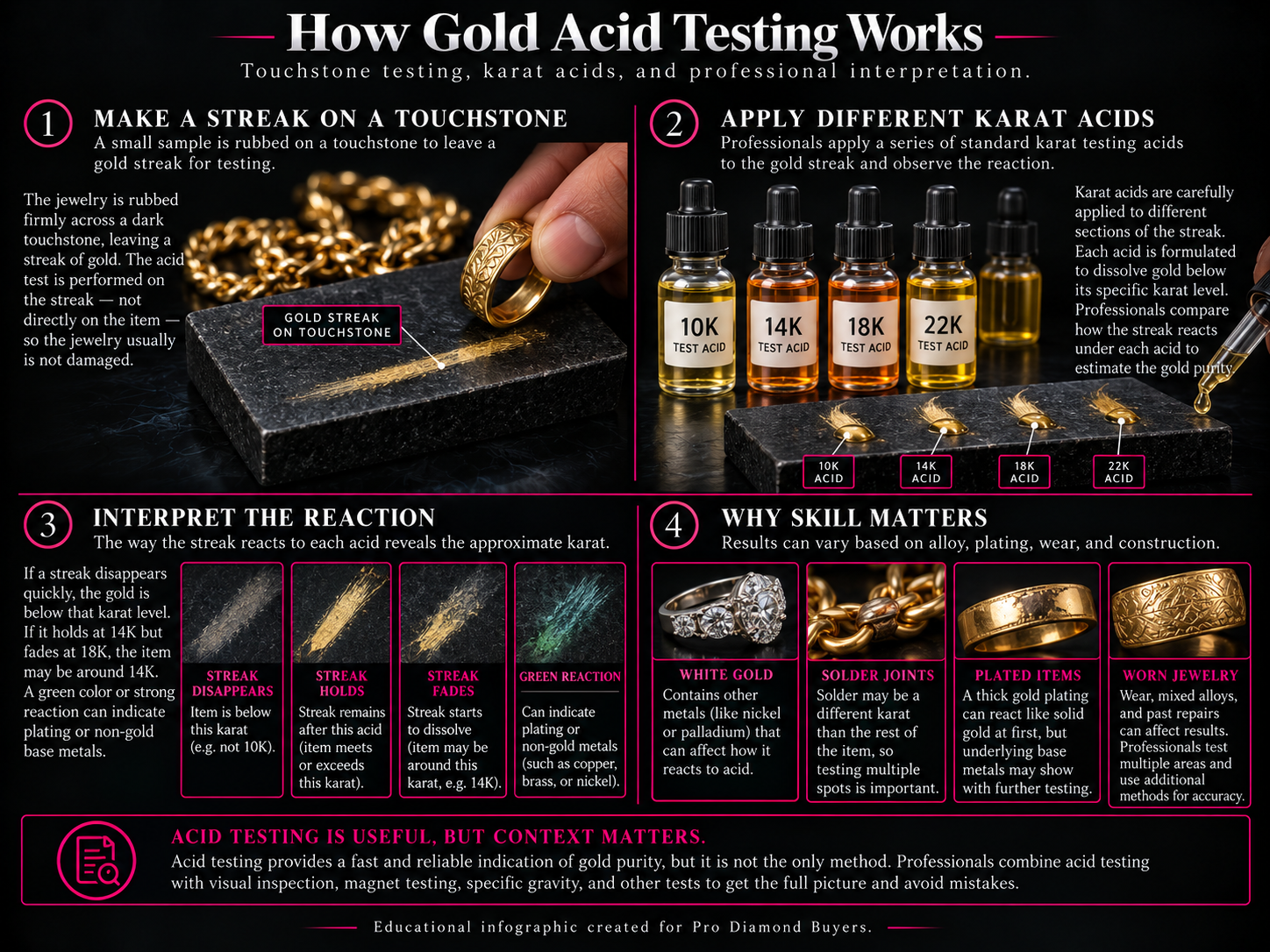
In the traditional touchstone method, a small portion of the item is rubbed firmly across a dark testing stone, leaving a visible metallic streak. Known karat-testing acids are then applied to sections of that streak.
The acids are formulated so that gold below a particular purity will react, fade or dissolve, while a sufficiently high-purity gold streak will resist the solution more effectively.
By comparing the reaction of the streak under different karat acids, an experienced tester can estimate the approximate purity of the item.
Why Stronger Acid Is Needed as Gold Karat Increases
This can seem counterintuitive at first. As the karat of gold rises, the amount of base metal in the alloy decreases. Yet stronger acid is required to test higher-karat gold.
The reason is that the purpose of the acid is not simply to attack the non-gold alloying metals. The test solution must be chemically aggressive enough to break down an alloy that contains an increasingly high proportion of gold.
A 10K alloy contains less than half gold and is relatively vulnerable to a lower-strength testing solution. An 18K or 22K alloy contains much more gold and is substantially more resistant to chemical attack. A stronger formulation is therefore required to distinguish whether the higher-purity alloy actually meets that karat threshold.
In practical testing, the question becomes: does the streak survive the acid intended for that karat, or does it begin to fade or dissolve?
Why Acid Testing Is Still a Benchmark Method for Gold Buyers
Modern instruments have made gold analysis faster and more sophisticated, but traditional acid testing remains one of the most dependable practical bench methods for evaluating gold jewelry.
One reason is that acid testing directly evaluates how exposed metal reacts to a known chemical standard. A hallmark can be false. Color can be misleading. A magnet can only screen for certain metals. Specific gravity can be affected by stones, hollow construction and mixed materials. XRF can provide excellent elemental data, but depending on the instrument, geometry and surface condition, the reading may be influenced by plating, solder, surface enrichment or the exact area being analyzed.
A properly performed acid test allows the tester to compare the metal against known karat-strength solutions and observe a real chemical reaction.
It is also extremely practical in a professional buying environment. Acid testing is fast, repeatable, inexpensive and can be performed on multiple areas of a piece. That matters because a bracelet, clasp, solder joint, repaired section and main body may not all be the same composition.
An experienced gold buyer can also test below plating when necessary, compare reactions across several acids and use the behavior of the streak to recognize when an item does not react like a normal gold alloy.
For these reasons, acid testing remains a core professional method even in offices equipped with advanced technology.
The strongest conclusions are usually reached by combining acid testing with visual inspection, weight, construction knowledge, specific gravity and XRF when additional confirmation is warranted.
Interpreting Gold Acid Reactions
Acid reactions are not simply a yes-or-no event. The speed, color and degree of reaction can provide useful information.
If a streak rapidly disappears under a particular karat acid, the metal is likely below that purity level.
If the streak remains substantially intact, the alloy may meet or exceed that karat threshold.
If the streak slowly fades, partially dissolves or changes color, the interpretation may be more complicated. White-gold alloys, plating, nickel, copper, silver, palladium and other metals can influence the appearance of the reaction.
Green coloration can indicate reaction with copper or other base metals, while some non-gold alloys may produce unusual yellow, gray or green residues.
This is one reason experience matters. The test is not simply about whether a line disappears; it is about understanding how real gold alloys normally behave compared with plated or base-metal materials.
Why White Gold Can Be More Difficult to Test
White gold is not a naturally white form of pure gold. It is gold alloyed with white metals such as nickel, palladium, silver or other elements.
Different white-gold formulations can therefore react differently under acid testing.
Many white-gold items are also rhodium plated. Rhodium plating can make the surface appear bright white even though the underlying alloy may have a warmer gray or yellow tone.
When a plated surface is tested without reaching the underlying metal, the result may describe the coating rather than the actual gold alloy beneath it.
Professional testing may require examining wear areas, making a deeper test mark or using another method to confirm the underlying composition.
Solder Joints, Repairs and Mixed Karats
Jewelry is often assembled or repaired using solder that does not have exactly the same composition as the surrounding gold.
A ring may be 14K while a repair joint contains lower-karat solder. A chain may contain a clasp with different metal components. Older jewelry may have accumulated several repairs over decades.
If the tester unknowingly tests only a solder joint, the result may underestimate the purity of the main item.
For this reason, professionals often test more than one location and pay close attention to seams, repairs and areas of different color.
Gold-Plated Jewelry
Gold plating can create one of the most common testing challenges.
A plated item may have genuine gold on the surface while the majority of the object underneath is brass, copper, silver or another base metal.
A shallow surface test can therefore produce a gold-like result even though the item contains only a thin layer of gold.
Wear points, edges and scratches can sometimes reveal the base metal beneath the plating. When necessary, a professional tester may expose a small area below the surface coating before testing.
Gold-Filled and Rolled-Gold Items
Gold-filled jewelry contains a mechanically bonded layer of gold that is substantially thicker than ordinary electroplating.
Because the outer layer may contain genuine karat gold, surface-only testing can initially behave like solid gold.
However, the core material is not solid gold. Accurate identification therefore requires understanding the construction of the item rather than relying on only the outer surface.
Hallmarks such as 1/20 12K GF, 1/20 14K GF or similar markings can provide clues, but professional testing should still confirm the construction when value is significant.
Specific Gravity Testing
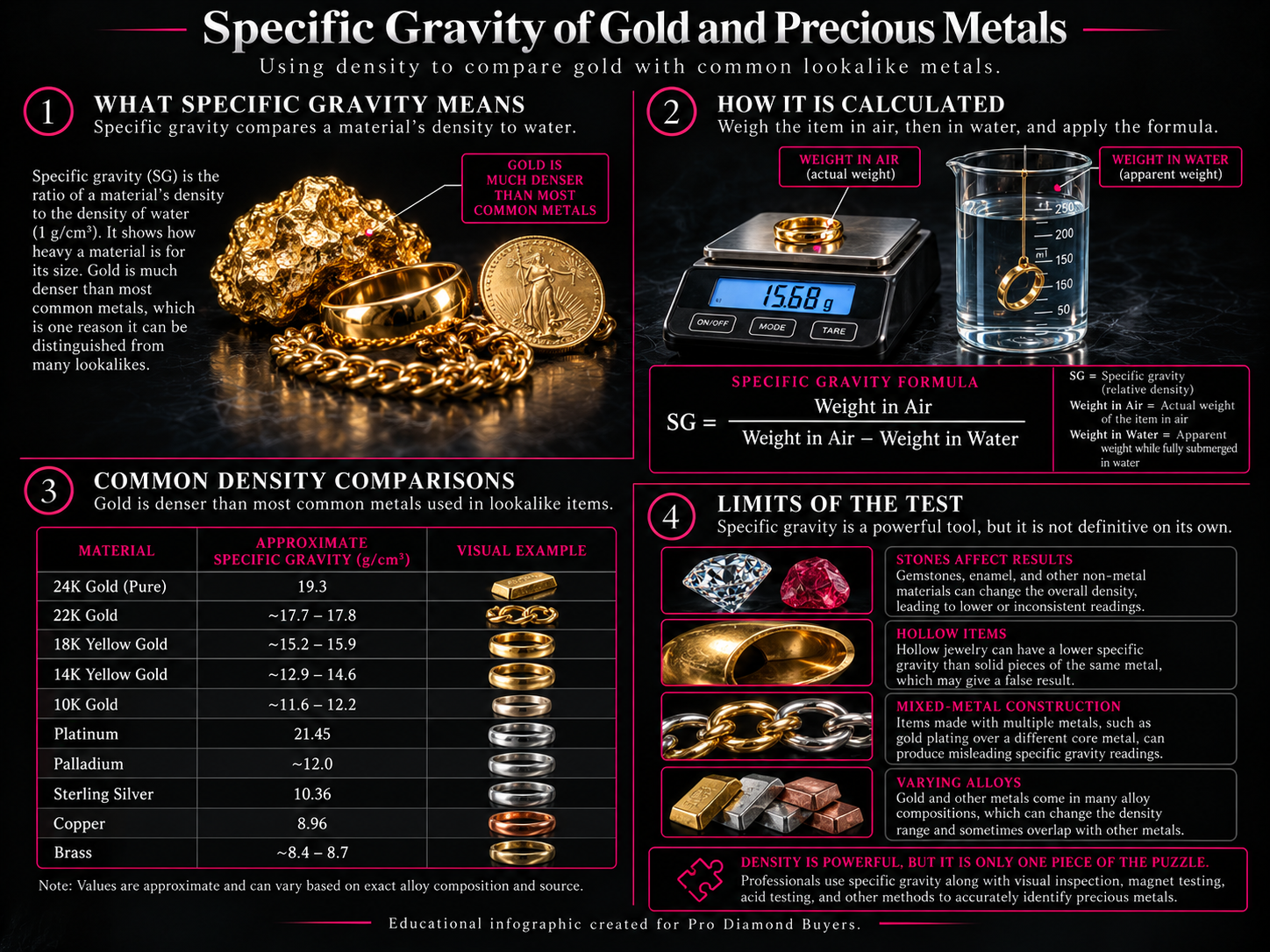
Specific gravity measures the density of a material relative to water.
Pure gold is extremely dense, with a specific gravity of approximately 19.3. Lower-karat gold alloys have lower densities because part of the gold has been replaced with lighter alloying metals.
A common hydrostatic method weighs an item in air and then measures its apparent weight while fully submerged in water.
The basic relationship is:
Specific Gravity = Weight in Air ÷ (Weight in Air − Weight in Water)
Because different metals have characteristic density ranges, specific gravity can help distinguish gold from many common substitutes.
Approximate Specific Gravity of Common Precious Metals
- 24K gold: approximately 19.3
- 22K gold: commonly around 17.7–18 depending on alloy
- 18K yellow gold: commonly around 15–16 depending on alloy
- 14K yellow gold: commonly around 13–14.5 depending on alloy
- 10K gold: commonly around 11.5–12.5 depending on alloy
- Platinum: approximately 21.45
- Palladium: approximately 12
- Sterling silver: approximately 10.36
- Copper: approximately 8.96
These numbers are approximate because jewelry alloys vary considerably.
Limits of Specific Gravity Testing
Specific gravity is powerful, but jewelry is often more complicated than a laboratory sample of a single metal.
Gemstones can change the apparent density. Hollow jewelry contains air space. Chains may contain multiple materials. Solder, enamel, springs and steel components can alter the result.
Two different alloys can also have overlapping density ranges.
Specific gravity is therefore best used as supporting evidence rather than as the sole method for identifying complex jewelry.
What Is XRF Gold Testing?
X-ray fluorescence, commonly called XRF, is a nondestructive analytical method used to estimate the elemental composition of metals.
An XRF instrument directs X-rays at the sample. The atoms within the material respond by emitting characteristic secondary X-rays. The instrument analyzes those signals to identify elements such as gold, silver, copper, nickel, zinc and palladium.
For professional gold buyers, XRF can be extremely useful because it can provide rapid information about the approximate elemental composition of an item without chemically dissolving the sample.
What XRF Can Tell a Gold Buyer
An XRF reading can help identify whether an item contains gold and estimate the percentages of the major metals present in the area being analyzed.
For example, an instrument may report a composition consistent with approximately 58.5 percent gold, which would correspond closely to a typical 14K alloy.
XRF can also help identify unusual alloys that behave differently under traditional acid testing.
This can be particularly valuable when testing white metals, unusual foreign jewelry, dental gold, high-karat alloys or pieces where the acid reaction is difficult to interpret.
Why XRF Is Not Automatically Perfect
XRF is sophisticated, but it should not be treated as infallible.
The instrument analyzes the material within a limited depth from the surface. Thick plating, surface enrichment, solder, contamination, curved surfaces and mixed-metal construction can influence the result.
A reading taken directly over a repair joint may describe the solder rather than the main item. A heavily plated object may initially show the composition of the coating rather than the core.
For this reason, an experienced operator considers where the reading is taken and whether the result makes sense when compared with the item’s weight, appearance, construction and other tests.
Why Gold Testing Can Become Complicated
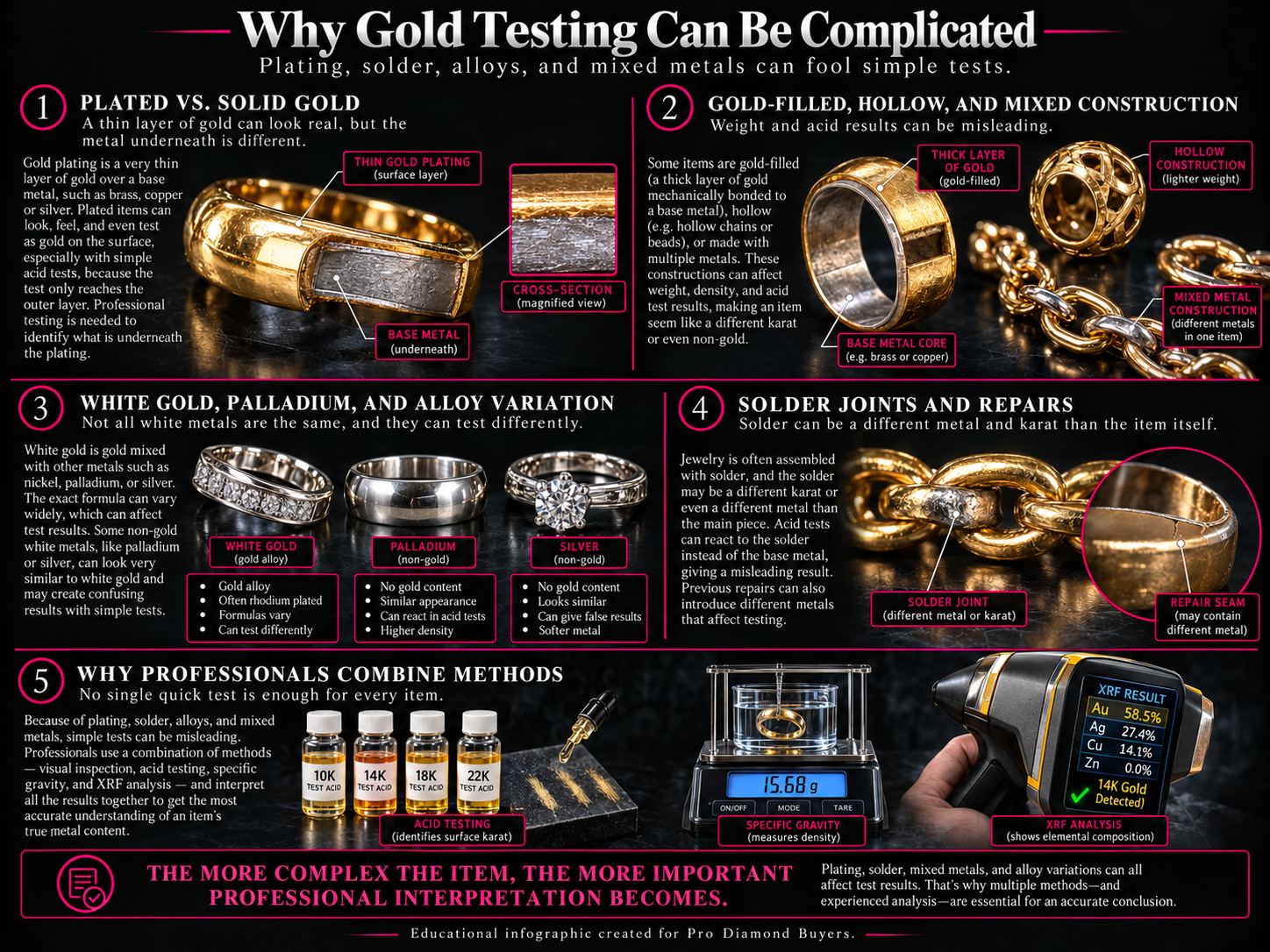
Simple pieces of solid gold can often be identified quickly. Other items require significantly more judgment.
Potential complications include:
- gold plating over base metal,
- gold-filled construction,
- rhodium-plated white gold,
- lower-karat solder joints,
- mixed-metal jewelry,
- hollow construction,
- gemstones and nonmetal materials,
- repairs performed with different alloys,
- foreign or unusual gold alloys,
- items manufactured from several different karats.
This is why no single quick test tells the entire story in every case.
Why Professionals Combine Gold-Testing Methods
The most reliable professional evaluation often comes from combining several forms of evidence.
A buyer may begin with hallmarks and visual inspection, screen the item with a magnet, perform a touchstone acid test and compare the weight and construction of the item.
If the results are unusual or the item is particularly valuable, specific gravity or XRF may provide additional confirmation.
Each method answers a slightly different question.
Visual inspection asks whether the item looks and is constructed like genuine gold jewelry. Acid testing asks how the exposed metal behaves chemically. Specific gravity asks whether the density is consistent with the expected alloy. XRF asks which elements are present in the area being analyzed.
When those independent observations agree, confidence in the conclusion becomes much stronger.
How Gold Purity Affects What a Buyer Pays
Gold value depends heavily on how much actual gold is contained in the item.
A 10K ring and an 18K ring may look similar, but the 18K item contains substantially more pure gold by weight.
Professional buyers therefore calculate value using factors such as:
- verified or estimated gold purity,
- net metal weight,
- current gold market price,
- stones or non-gold components,
- manufacturing or resale value when applicable,
- condition and marketability of the item.
Accurate testing is therefore not separate from valuation. It is the foundation of the valuation.
How Pro Diamond Buyers Tests Gold Before Making an Offer
At Pro Diamond Buyers, gold testing is performed with the understanding that jewelry cannot always be accurately identified by one quick test.
We examine the entire item, including hallmarks, construction, wear, repairs, solder joints, plating and other characteristics that may affect the result.
Depending on the item, we may use multiple testing methods to confirm purity before determining value.
This is particularly important when evaluating estate jewelry, scrap gold, mixed-karat pieces, unusual white metals, coins, bullion and jewelry that has been repaired or modified over time.
Our goal is to identify what the item actually contains so that an offer can be based on the real gold content and any additional value the piece may have.
Gold Testing Is Both Science and Experience
Gold identification is based on measurable physical and chemical properties, but professional interpretation still matters.
A testing method may provide a number or a visible reaction, but someone still has to determine whether that result is consistent with the object being examined.
A strong magnetic response, an acid streak that fades unexpectedly, an unusual specific-gravity reading or an XRF result that conflicts with the construction of the item should not simply be accepted without further investigation.
The most dependable gold testing combines chemistry, physics, instrumentation and practical jewelry knowledge.
That combination is what allows an experienced gold buyer to distinguish solid gold from plated material, identify mixed construction, estimate karat accurately and recognize when an item requires additional testing before an offer is made.
Scientific Sources and Further Reading
This article was written by Pro Diamond Buyers using our professional gold-buying and precious-metals testing experience together with established gemological and metallurgical principles. The concepts are explained in our own words for educational purposes.
- Gemological Institute of America — touchstone methods for testing karat gold
- Gemological Institute of America — X-ray fluorescence applications in jewelry and precious-metal analysis
- Standard density and specific-gravity references for gold and precious-metal alloys
- Professional precious-metal testing practices used in jewelry buying, refining and gemological evaluation
Pro Diamond Buyers is an independent diamond and precious-metals buyer. Educational references are provided for scientific and technical context and do not imply sponsorship or endorsement by any outside organization.


